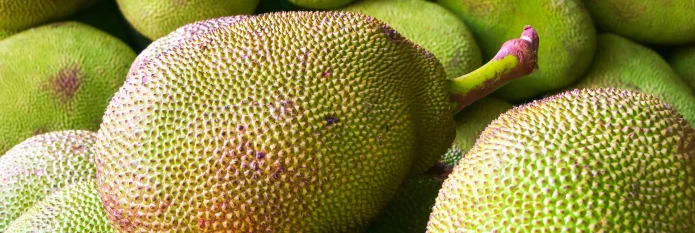
A large, spiky, green-coloured fruit called ‘jackfruit’ has been making appearances at markets and restaurant menus around the world. In 2017, Pinterest even declared it the top food trend of the year. Find out where jackfruit comes from and how is it grown and harvested.
What is jackfruit?
Jackfruit (Artocarpus heterophyllus) is the fruit of a tree native to the western coast of India.1 While it has recently gained popularity in the West, European natural historians have known about it for over 300 years. Historical records indicate that it gets its name from the word ‘chakka’, which is the fruit’s name in the Indian language Malayalam.2
The jackfruit tree is a member of the Moraceae family, making it a cousin of the fig and mulberry plants. Jackfruit is the largest tree-borne fruit in the world, with each fruit weighing between 10 and 25 kg.4 Jackfruit trees are known to bear up to 150 fruits per year.4
Which jackfruit parts are edible?
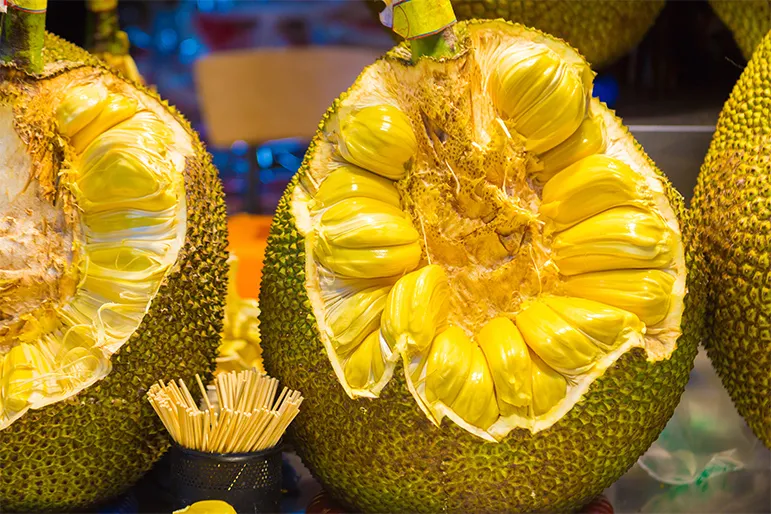
The fruit consists of 3 parts – the central core, fleshy bulbs, and the outer skin. Of this, the bulb and the seed within the bulb are edible.
Where does jackfruit come from?
Jackfruit grows in tropical and subtropical parts of the world, such as India, Malaysia, Central and Eastern Africa, the Caribbean, Florida, Brazil, Australia, Puerto Rico and many Pacific Islands.5
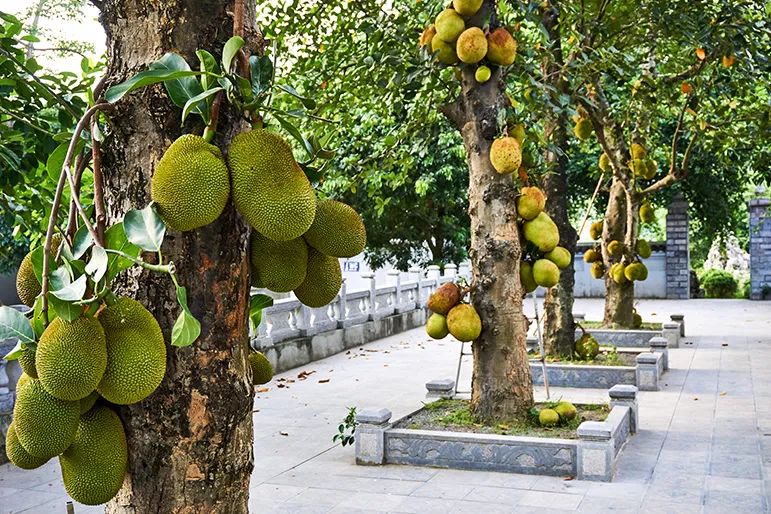
Unlike other fruit-bearing trees, jackfruit trees are often not grown in orchards. In native countries, they are roadside flora meant to provide shade or break wind.4 They also grow in forests and are sometimes planted in woodlots.4 Jackfruit trees require very few resources to flourish, making them an essential source of nutrition, timber, and animal fodder in local food systems.4
How Jackfruit is harvested
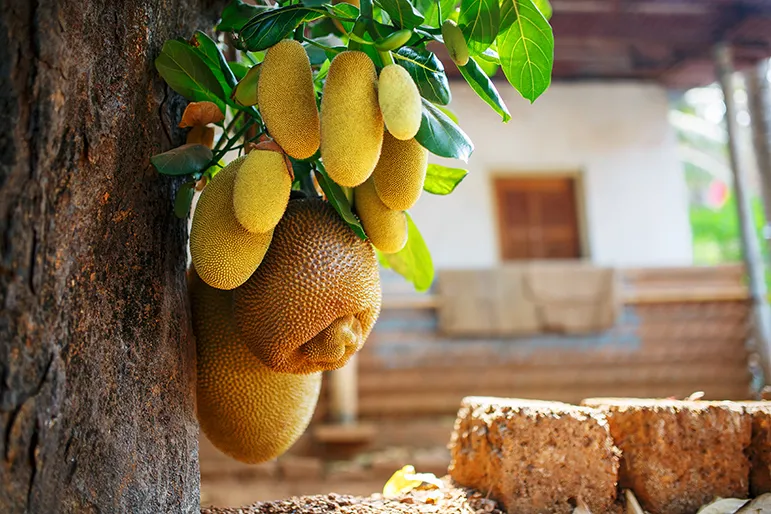
Jackfruits can be harvested and consumed when they are unripe (often referred to as a vegetable at this stage) or when they have matured. The unripe jackfruit must be cooked before consumption and is famous for its meat-like texture, frequently compared to pulled pork or chicken breast. Ripe jackfruit’s bulbs are sweet and yellow or orange. They can be eaten fresh or made into desserts such as ice creams or puddings. A ripe jackfruit’s taste is often described as a cross between a banana and a pineapple (as tropical as it gets!).
Processing jackfruit to separate the edible parts is tedious because of its large size and hard skin. Like all other parts of its tree, the jackfruit contains high amounts of latex (a glue-like substance produced by plants), making handling and cutting challenging for the untrained. The latex can also cause an allergic reaction in some people.6 But Jackfruit latex can also be a natural resource. It doesn't have the suitable properties to replace natural rubber completely, but it could be a valuable additive to rubber. For example, one study found it could reduce the risk of car tyres skidding in wet weather.8
In Brazil, the jackfruit tree is considered to be an invasive species. It was introduced in the region in the late 17th century and now outcompetes local trees.7