Getting young children to eat their greens is a problem for many parents. New vegetable picture books mean it doesn't have to be a battle at the dinner table!
Children aren’t eating enough vegetables
Few people would dispute that vegetables are a fundamental part of a healthy, balanced diet, with many countries recommending that 5 or more portions of fruit or vegetables be eaten daily.1 However, when we look at what people actually eat, particularly children, there is a clear shortfall in reaching these amounts. In the UK, only 18% of children aged 5 to 15 years eat the recommended 5-a-day and in other parts of Europe the figures are similarly low.2,3 With growing numbers of children classed as overweight or obese across the world,4 it is clear that there needs to be a shift towards more healthy food choices, and especially an increase in vegetable consumption. Knowing that what we eat as children often follows into adolescence and adulthood provides us with an opportunity to support good health long-term by establishing healthy food preferences early on.
Why do children dislike vegetables?
Parents know that vegetables can be difficult foods to persuade children to eat. As babies we all have a preference for sweet flavours and naturally reject sour and bitter-tasting foods.5 Unfortunately, many of the most nutritious vegetables, including cabbage and leafy greens (broccoli, brussels sprouts, cauliflower) are those commonly disliked by children because of their slight bitter taste. This can create an initial barrier to eating these and other vegetables.
Alongside the obstacle of how vegetables taste, the way children develop food preferences can also make it a challenge to incorporate vegetables into their diet. Children around 18 months of age start categorising foods as familiar or unfamiliar and showing a strong aversion to new foods, known as ‘food neophobia’.6 Rejection of all new foods can cause considerable stress for parents who are trying to provide healthy meals but are instead faced with a fussy child and tantrums! So, how do you get kids to eat vegetables?
Making vegetables familiar is key
How familiar you are with a food is a crucial indicator of whether you are likely to eat it. This is the case not only for children but for adults too.7 So, the easiest way to combat food neophobia in children is to make food more familiar. Ideally, familiarity arises through exposing children to new foods multiple times and through different recipes – if a child can be persuaded to taste an initially rejected food on multiple occasions, the evidence suggests that the food will eventually be accepted.8 However, it might take 10-15 rejections before a new food is accepted, requiring considerable patience from parents, many of whom confess they give up after 3-5 attempts.9 Taste exposure is not the easiest technique for parents trying to encourage their child to eat more vegetables. Parents commonly find mealtimes with children stressful and challenging, and techniques currently recommended to families are not supporting recommended levels of vegetable consumption.
The power of picture books
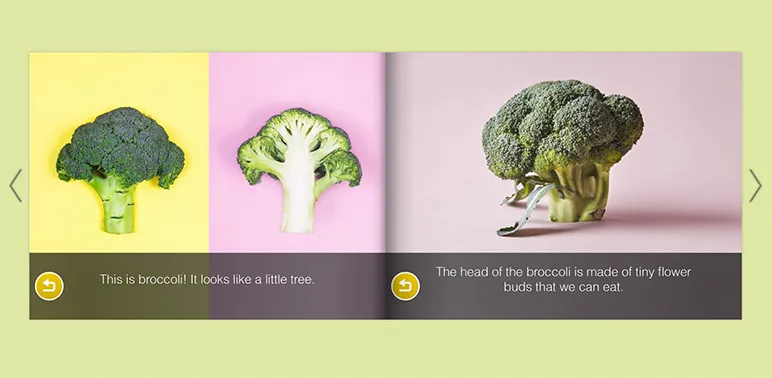
An alternative way to increase food familiarity is through pictures. Research has shown that the more often you see something, the more you like it,10 and visual familiarity can, therefore, encourage a more positive attitude toward a new food before it has even been offered to taste. For young preschoolers, visual familiarity with vegetables can be provided through picture books showing illustrations of vegetables and telling their stories. Studies have shown that looking at picture books with a toddler for a few minutes each day for two weeks can make children more accepting of the food in the book, making them more willing to try the vegetables, and to eat more of it and like it more when they actually taste it.11 These positive effects have been found using physical books and ebooks viewed on smartphones or tablets. Ebooks have the added bonus of enabling interactivity and personalisation of the books via a dedicated app that makes learning about vegetables fun and engaging for the whole family.
If you're a teacher looking to engage your students with the food on their planet - you can check out the brilliant food systems teaching resources from our sister project, Food Educators.
For more teaching resources, have a look through the School Network Resources’ UK Activity Pack for parents and teachers or check out the new vegetable ebooks at the See&Eat project.